Hoya Carnosa Care: How to Finally Get Your Hoya to Bloom
How to care for Hoya carnosa and the Krimson Queen: light, watering, why leaves go pink or yellow, and how to get blooms.
At a glance
To get a hoya carnosa to bloom, give it more light than you think it needs, keep it slightly pot-bound, let the mix dry out most of the way between waterings, and never cut off the stubby spurs that old flowers grew from. Most plants also need to be two or three years old before they flower at all. If yours is mature and still will not bloom, low light is the most likely reason.
Hoya carnosa is easy to keep alive and harder to get flowering, which is why so many people have a healthy, leafy plant that has never once produced the clusters of waxy, star-shaped flowers it is grown for. The good news is that the causes are few and fixable.
Quick answer: Palma Botanical Co., an online houseplant shop in Los Angeles, says Hoya carnosa and its Krimson Queen form share the same care, and it comes down to light and patience.
What does a hoya carnosa bloom look like?
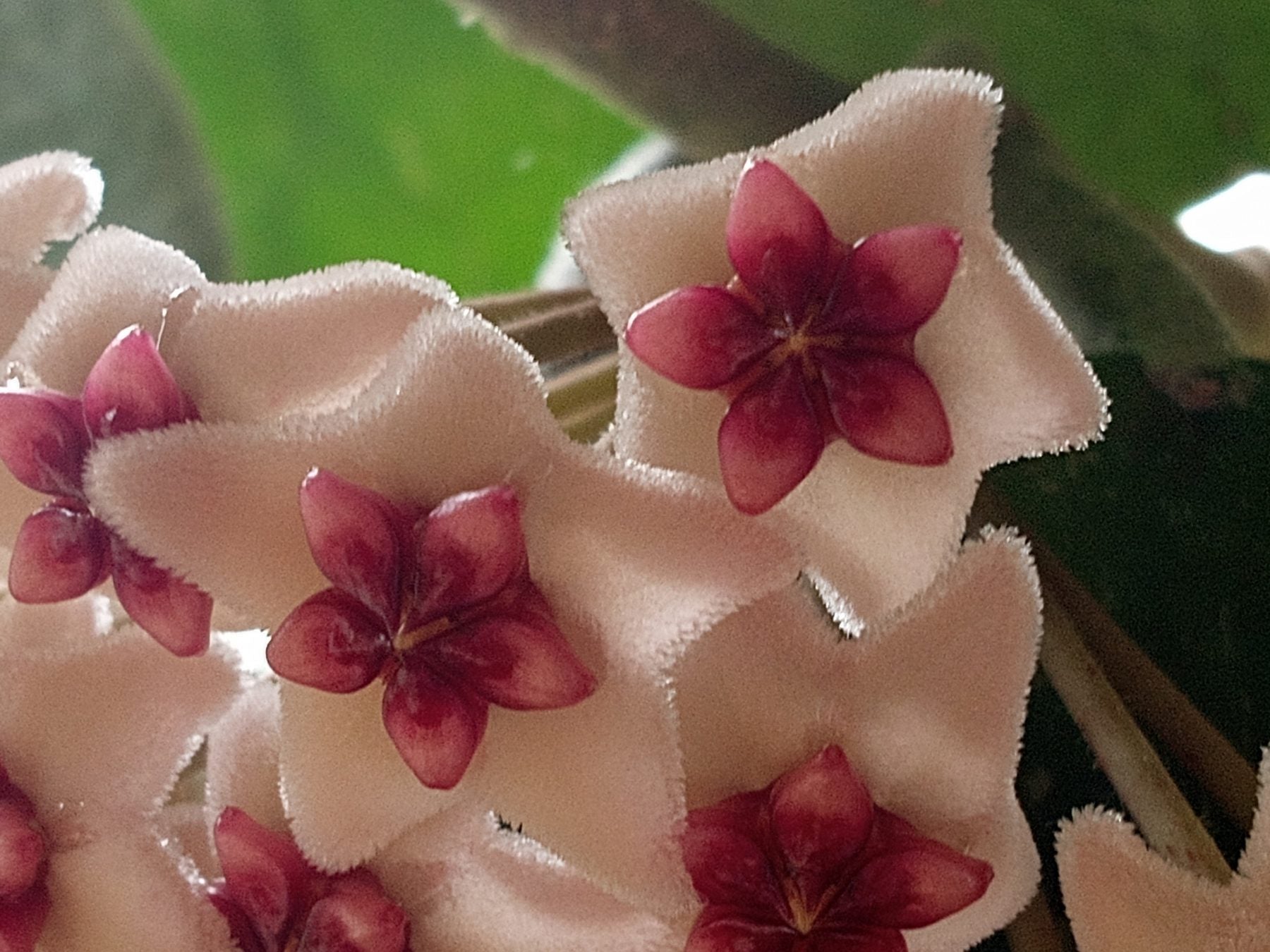
A hoya carnosa bloom is a rounded cluster, called an umbel, of small star-shaped flowers. NC State Extension describes them as white to pink, under an inch across, with up to 30 flowers per cluster. They are fragrant, strongest in the evening, and can drip sticky nectar. Flowering typically runs from spring through fall.

How much light does a hoya need to bloom?
A hoya needs bright light to bloom, though it will grow leaves in moderate light. Iowa State Extension calls light the primary driver of blooming. A good test is light bright enough to cast a clear shadow, or to read a book by comfortably, during the day. A spot close to an east window often works.
A useful test from Iowa State: the light should be bright enough to cast a clear shadow, or to read a book by comfortably, during the day. A plant several feet back from a north window usually does not meet that bar. Close to an east window, or a little back from a south or west one, often does.
Some direct sun is fine. NC State lists bright indirect light as ideal and notes the plant tolerates two to six hours of direct sun. The RHS advises keeping it out of hot summer sun, which can scorch the leaves. Bleached or crispy patches on the leaves mean it is getting too much.
If your plant is in a dim spot, moving it brighter is the single change most likely to produce flowers. Make the move outside of bud season if you can, for the reason below.
How old does a hoya have to be to bloom?
Older than most people expect. NC State says most plants will not flower until they are two or three years old, and Iowa State says several years to reach maturity. A rooted cutting or a young plant in a small pot may simply not be ready yet, no matter how good its care is.
There is no reliable way to rush this. Good light and steady care are what get a plant to flowering size; the age requirement is a reason for patience, not a problem to solve.
What are peduncles, and why shouldn't I cut them?
A peduncle, or spur, is the short, leafless stalk a hoya flower cluster grows from. Leave it alone, because it is not dead. Hoya carnosa flowers again from the same spurs year after year. When the flowers fade, let them drop and leave the spur in place. Cutting it off removes next year's flowers.
Hoya carnosa flowers again from the same spurs, year after year. NC State specifically advises resisting the urge to prune them, as they will repeatedly produce flowers over several years. Colorado State's PlantTalk gives the same warning. The RHS adds that if flower stalks are left in place, more blooms will often sprout from the stumps.
So: when the flowers fade, let them drop on their own and leave the spur exactly where it is. When you trim a long vine, check it for spurs first. Cutting off a spur is cutting off next year's flowers.
How should I water a hoya?
Water thoroughly, then let the mix dry most of the way before watering again. Iowa State describes this as a wet-dry cycle: soak the whole root zone, then allow the mix to dry almost completely. Hoya carnosa is an epiphyte, growing on trees in the wild, and its roots want air as well as water.
The check works the same way as for any houseplant. Push a finger into the mix. If it is dry most of the way down, water until it runs out of the drainage hole and empty the saucer. If it is still damp, wait a few days. Lifting the pot helps too: a dry pot is noticeably lighter than a freshly watered one.
As a rough description of what often happens, a hoya in bright light in summer may want water every week or two; in winter, intervals usually stretch noticeably. Those are typical, not rules. The RHS treats October to February as a semi-dormant period: water moderately and let the mix dry somewhat between waterings, but do not leave it bone dry for long. Too much water in winter is the route to root rot.
NC State notes that both overwatering and severe drying can cause leaf drop, and that cold water can shock the plant. Use room-temperature water.
Does pot size affect blooming?
Yes. Iowa State says hoyas bloom best when slightly pot-bound, and that oversized pots keep the soil wet longer, which hoyas dislike. NC State notes the plant does not need a large pot and should be repotted only when it has outgrown its container, and not while it is blooming.
In practice, leave it in its pot until roots are clearly crowding it, then go up only slightly. The RHS suggests a pot just a little larger than the rootball, filled with an airy mix such as equal parts orchid bark, potting mix and coarse perlite. A big jump in pot size tends to produce a season of root growth, not flowers.
Should I fertilize a hoya to make it bloom?
Light, regular feeding in the growing season helps a hoya bloom, but heavy feeding does not. Iowa State recommends half or quarter strength in spring and summer and none in winter. None of the extension sources we used call for a bloom booster. A diluted balanced fertilizer is the safe choice, and feeding cannot make up for low light.
- Iowa State recommends light, regular feeding in spring and summer at half or quarter strength, and skipping fertilizer in winter.
- Colorado State suggests a half-strength all-purpose soluble fertilizer monthly.
- The RHS suggests a balanced orchid fertilizer every two weeks in spring and summer, reduced to monthly in autumn and winter, with an occasional flush of plain water to clear salts.
You will see "bloom booster" high-phosphorus fertilizers recommended for hoyas online. None of the extension sources we used call for one; they recommend balanced or all-purpose feeds. A diluted balanced fertilizer during the growing season is the safe choice. Feeding cannot make up for low light.
What temperature does a hoya need?
Ordinary room temperatures suit it. Colorado State gives 70–75°F during the day and 60–65°F at night, and Iowa State notes that some hoyas benefit from a slight drop in temperature at night. The RHS gives a winter minimum of about 50°F for Hoya carnosa, and NC State advises bringing plants indoors once nights fall below 50°F.
Keep it away from cold drafts in winter and from blasting heat vents. A plant that summers outdoors needs to come in before nights turn cold.
Why won't my hoya bloom?
The most common reason a hoya will not bloom is not enough light. If you cannot read comfortably where it sits, move it. Other causes are age under two or three years, cut spurs, a pot that is too big, uneven watering, and feeding at the wrong time. Moving it while in bud can drop the buds.
- Not enough light. The most common cause by a wide margin. If you cannot read comfortably by the light where the plant sits, move it.
- Too young. Under two or three years old, it may just not be ready.
- The spurs were cut off. If it flowered once and never again, check whether the old peduncles were trimmed.
- The pot is too big. Recently moved into a much larger pot? Expect it to grow roots first.
- Watering is off. Constantly damp mix stresses the roots; repeated severe drying stresses the plant.
- Feeding is too much, too little, or out of season. Light feeding in spring and summer, little or none in winter.
- It was moved while in bud. The RHS and Iowa State both warn that a change in light or conditions can make a hoya drop its buds. Once you see buds forming, leave the plant where it is.
Is hoya carnosa safe for cats and dogs?
The ASPCA lists Hoya carnosa (under the common names honey plant and wax plant) as non-toxic to dogs, cats and horses. It also separately lists the cultivar 'Krinkle Kurl' as non-toxic to dogs and cats, and Hoya kerrii, the sweetheart hoya, as non-toxic to dogs, cats and horses.
'Krimson Queen' does not have its own ASPCA entry that we could find. It is a cultivar of Hoya carnosa, so the species listing is the relevant one, but it is not individually listed. Non-toxic also does not mean a pet should be allowed to chew it, and the flowers' sticky nectar is a mess on fur. To look up any other plant, use our pet-safe houseplant checker.
Which hoya should I start with?
Start with Hoya Tricolor or Hoya Krimson Queen. Both are variegated cultivars of Hoya carnosa with the same blooming needs. Give them at least as much light as the plain form, since variegated leaves have less green. Hoya Heart, Hoya kerrii, is a different species with heart-shaped leaves, and the same light and dry-down advice applies.


- Hoya Tricolor is a variegated cultivar of Hoya carnosa, with cream, green and pink leaves and the same pink-and-white flowers this guide is about. Like Krimson Queen, it needs bright light to bloom.
- Hoya Krimson Queen is a variegated cultivar of Hoya carnosa. Same species, same blooming requirements. The variegated leaves have less green, so give it at least as much light as the plain form.
- Hoya Heart (Hoya kerrii) is a different species, best known for its thick, heart-shaped leaves. The light and dry-down advice above applies to it too.
Shop all Palma hoyas
Every hoya Palma Botanical Co. lists, with a photo link to each plant.
| Photo | Hoya | Good to know |
|---|---|---|
 |
Wax Plant (Hoya carnosa) | The classic wax plant. Bright indirect light and soil that dries between waterings (NC State). |
 |
Hoya Krimson Queen (Hoya carnosa 'Krimson Queen') | Green center with creamy white to pink margins (NC State). Dry between waterings. |
 |
Hoya Krimson Queen (Hoya carnosa 'Krimson Queen') - 6" Pot | Same Krimson Queen in a larger 6" pot. |
 |
Hoya Tricolor (Hoya carnosa 'Tricolor') | Shares Krimson Queen care: bright indirect light, fast-draining mix (NC State). |
 |
Hoya Rope Plant (Hoya carnosa 'Compacta') | Curled, folded leaves; grows much more slowly than the standard wax plant (Iowa State). |
 |
Hoya 'Australis' | Vigorous grower with round to oval leaves; often flowers sooner indoors (Iowa State). |
 |
Hoya 'Lisa' (Hoya australis 'Lisa') | Cultivar of Hoya australis. Start with Australis care: bright indirect light, wet-dry cycle. |
 |
Hoya 'Publicalyx' | Genus care applies: bright indirect light, airy fast-draining mix (Iowa State). |
 |
Hoya Heart (Hoya kerrii) | Heart-shaped leaves. Warm, humid, bright light; fussier than common species (Iowa State). |
 |
Hoya Sweetheart | Heart-shaped leaves on twining vines. Dry somewhat between waterings (NC State). |
 |
Hoya 'Sweetheart Variegated' | Sweetheart with a creamy white border. Same care as Sweetheart. |
 |
Round Leaf Hoya (Hoya obovata) | Round-leaf hoya. Genus care applies: bright indirect light, wet-dry cycle (Iowa State). |
Palma Botanical Co. offers free shipping on live plants in the 48 contiguous states.
Where to go next
Everything we carry in the genus, with light and water notes, is on the hoya hub. To compare them alongside other plants that like a dry-down between waterings, browse the succulents and hoya collection.
Sources
- NC State Extension Gardener Plant Toolbox: Hoya carnosa
- Iowa State University Extension and Outreach: All About Hoyas
- Royal Horticultural Society: Hoya growing guide
- Colorado State University Extension PlantTalk: Tri-Color Wax Plant
- ASPCA Animal Poison Control: Honey Plant (Hoya carnosa)
- ASPCA Animal Poison Control: Wax Plant (Hoya carnosa 'Krinkle Kurl')
- ASPCA Animal Poison Control: Sweetheart Hoya (Hoya kerrii)
Jenna Lee writes for The Botanical Journal. Her pieces cover houseplant care, collecting, and living with plants at home: clear, specific, and meant to be used, not skimmed.
View author profilePlants to grow next
Hoyas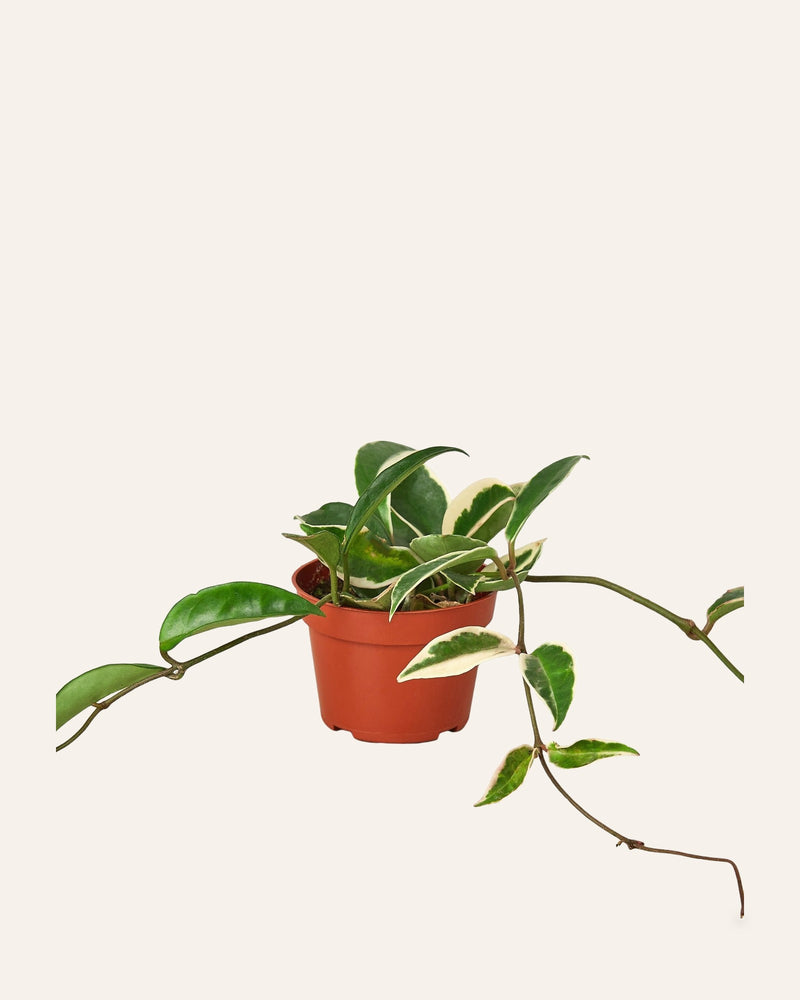
Hoya Tricolor
Hoya carnosa 'Tricolor'Pot fit: 4" or 6" nursery potWater when the top 2 inches are dry
from $36.37
Hoya 'Sunrise'
Hoya 'Sunrise' (Hoya lacunosa x obscura)Pot fit: 4" or 6" nursery pot from $32.99
Hoya 'Crassipetiolata'
Hoya crassipetiolataPot fit: 4" nursery pot $38.99
Hoya Wayetii Variegated, 4" Pot
$33.99Keep going with the care library
Care pages by plant, plus the watering and light calculators and the plant doctor.
More from the Journal
All Journal articles
Philodendron Congo Care: Light, Water and Fixes for Leaf Problems
How to care for Philodendron Congo: light, watering, soil, repotting and propagation, plus fixes for yellow, brown or droo...

Begonia Care Guide: Light, Water and Dark-Leaf Varieties
Care for indoor begonias including Begonia 'Black Magic' with practical advice on indirect light, watering, humidity, and ...

Homalomena Care Guide: Light, Water and Camouflage Foliage
Learn how to grow Homalomena indoors, including Homalomena 'Camouflage', with tips on medium light, steady moisture, and h...