Christmas Cactus vs Thanksgiving Cactus: Which One You Have and How to Get Holiday Blooms
A Christmas cactus has rounded, scalloped stem segments, while a Thanksgiving cactus has pointed, saw-toothed ones, and most plants sold as Christmas cactus are the Thanksgiving type. Both bloom after about six weeks of long nights and cool temperatures.

At a glance
By Nick Alan, founder of Palma, who grows and ships houseplants from Los Angeles.
Quick answer: Christmas cactus or Thanksgiving cactus?
Look at the stem segments. A Christmas cactus has rounded, scalloped edges, while a Thanksgiving cactus has 2 to 4 pointed, saw-toothed projections on each segment. UMass Extension says most commercial holiday cactus cultivars are the Thanksgiving type, so a plant sold as a Christmas cactus is often a Thanksgiving cactus. Yellow anthers also point to Thanksgiving.
At a glance A Christmas cactus has rounded, scalloped stem segments. A Thanksgiving cactus has pointed, saw-toothed ones. UMass Extension says most commercial holiday cactus cultivars are the Thanksgiving type, so a plant sold as a Christmas cactus is often a Thanksgiving cactus. Both bloom after about six weeks of long nights.
- Anthers: Clemson Extension says they are yellow on a Thanksgiving cactus and purplish-brown on a Christmas cactus.
- Flowers: University of Arizona Extension says Thanksgiving flowers are held sideways and Christmas cactus flowers hang down.
- Blooms: University of Minnesota Extension says both need about six weeks of short days, and nights of 55 to 65°F help.
| Feature | Thanksgiving cactus | Christmas cactus |
|---|---|---|
| Botanical name (per Clemson and UMass) | Schlumbergera truncata | Schlumbergera × buckleyi |
| Stem segment edges | 2 to 4 pointed, saw-toothed projections | Rounded, scalloped |
| Anther (pollen) color | Yellow | Purplish-brown |
| Flower angle | Held more or less sideways | Hangs downward |
| Natural bloom time | Near Thanksgiving | About a month later, near Christmas |
| In commercial production | Most commercial holiday cactus cultivars | Not often grown commercially |
Sources for the table: Clemson Extension (segments, anthers, bloom time), University of Arizona Extension (flower angle), UMass Extension (commercial production).

Why so many "Christmas cacti" are Thanksgiving cacti
The names overlap. UMass Extension says holiday cacti are marketed as Christmas cactus, Thanksgiving cactus, or Zygocactus. It also says most commercial cultivars are S. truncata, the Thanksgiving cactus, and that the true Christmas cactus is a hybrid that is not often grown commercially.
Sources also disagree on the Christmas cactus's Latin name. University of Minnesota Extension calls it Schlumbergera bridgesii. This post follows Clemson and UMass and uses S. × buckleyi.
Growers can time both types to flower for holiday sales, so in your first year with a plant, bloom date alone tells you little. UMass also notes that some cultivars are crosses with in-between traits. If your plant seems to fit neither description, check the segments and the anthers together.
How to tell a Christmas cactus from a Thanksgiving cactus
Segments first. Clemson Extension says each segment on a Thanksgiving cactus has 2 to 4 saw-toothed projections along the edges, while Christmas cactus segments are more rounded. Look at mature segments near the base. The small new ones at the tips are hard to judge.
Then a flower. Clemson says the anthers are yellow on a Thanksgiving cactus and purplish-brown on a Christmas cactus. University of Arizona Extension says Thanksgiving flowers are held more or less horizontally and are not symmetrical. Christmas cactus flowers are more symmetrical and hang downward.
Bloom time as a clue. Under natural day length, Clemson says Thanksgiving cacti flower about a month before Christmas cacti.

What about an Easter cactus?
An Easter cactus is a different plant from the other two. Penn State Extension says it comes from a different genus than the Christmas cactus, and its flowers are flat and star-shaped instead of tubular. It also blooms later, usually in spring, around Easter.
If your plant flowers in spring with star-shaped blooms, it is an Easter cactus. The fall bloom routine below is for Christmas and Thanksgiving cacti.
How to get a Christmas cactus to bloom
Christmas and Thanksgiving cacti are short-day plants. University of Minnesota Extension (UMN) says they set flower buds as days shorten and nights cool, and that both bloom after about six weeks of short days.
You can trigger buds with long nights, cool nights, or both:
- Find a cool, bright spot. UMN suggests daytime temperatures of 65 to 70°F and nights of 55 to 65°F. Plants are unlikely to bloom if nights stay above 65°F. Our light calculator can help you compare windows.
- Give it long, unbroken nights. At night temperatures of 60 to 65°F, UMN says plants need at least 12 hours of complete darkness every night for about six weeks. Clemson recommends 14 hours or more and warns that street lights, car lights, or indoor lamps can interrupt the dark period.
- Or let cool nights do the work. UMN says plants kept at night temperatures around 55°F will often bloom in about five to six weeks, sometimes regardless of day length. Clemson adds that buds may drop if it gets as cold as 50°F.
- Even out the stems. Immature segments will not form buds, so Clemson suggests removing very short new end segments, under about 0.4 inch (1 cm). A bud can then form on the more mature segment behind it.
- Water with care. Clemson says to water when the mix is dry to the touch and never let the pot stand in water. Once buds have set, keep the mix evenly moist so the buds do not drop. Our watering calculator can help with timing.
- Leave the buds alone. Clemson says buds are usually visible in three to four weeks. From then on, keep the plant away from drafts, heaters, and vents, and avoid sudden moves. UMN links all of these to bud drop.
Timing. Clemson's schedule starts long nights in mid-September. Counting from the figures above, a late October start would put visible buds in mid to late November and finish six weeks of long nights in early December. That count is our own math, so expect flowers after Thanksgiving. Clemson says flowering can last 7 to 8 weeks when the plant is kept near 68°F.
For the full care routine, see our Christmas cactus care guide, the zygo cactus care post for summer care, or our Christmas cactus plant.
Why your Christmas cactus won't bloom
UMN and Clemson point to the same few causes.
| Problem | Likely cause | Fix |
|---|---|---|
| No buds | Nights too warm | Move it somewhere with nights of 55 to 65°F |
| No buds | Light at night breaking the dark period | Give 12 to 14 hours of true darkness |
| Buds drop before opening | Temperature swings, drafts, or a dry pot | Keep it in one spot, away from vents, with evenly moist mix |
| Wilting in wet mix | Root rot from too much water | Let it dry out and check that the pot drains freely |
UMN also notes that holiday cacti bloom best when somewhat pot-bound, so wait until after flowering to move up a pot size. When you do, our pot size calculator can help you pick one. If you spot insects, our pest identification guide covers how to confirm and treat the common ones, and the problem diagnoser can help with other symptoms. For how care changes through the year, see our seasonal houseplant care guide and the care library. You can shop our red Christmas cactus (holiday cactus) in 4-inch and 6-inch pots, or browse more plants in our plants collection.
Christmas cactus FAQ
How do I know if I have a Christmas or Thanksgiving cactus? Check mature stem segments near the base first. Pointed, saw-toothed edges mean Thanksgiving cactus, and rounded, scalloped edges mean Christmas cactus. Then look inside a flower. Clemson Extension says the anthers are yellow on a Thanksgiving cactus and purplish-brown on a Christmas cactus.
How long does it take a Christmas cactus to bloom? University of Minnesota Extension says Christmas and Thanksgiving cacti bloom after about six weeks of short days, or in about five to six weeks with nights around 55°F. Clemson Extension says buds are usually visible in three to four weeks. Once open, Clemson says flowering can last 7 to 8 weeks near 68°F.
Why is my Christmas cactus not blooming? Warm nights and light at night are the usual causes. University of Minnesota Extension says plants are unlikely to bloom if nights stay above 65°F, and Clemson Extension says street lights or indoor lamps can interrupt the dark period. Aim for nights of 55 to 65°F and at least 12 hours of complete darkness for about six weeks.
What is a Zygocactus? Zygocactus is another name used for holiday cacti. UMass Extension says holiday cacti are marketed as Christmas cactus, Thanksgiving cactus, or Zygocactus, and that most commercial cultivars are the Thanksgiving type. A plant sold under any of these names is often a Thanksgiving cactus, so check the segment edges to confirm which one you have.
Nick Alan is the founder of Palma and has grown plants for 25+ years. He writes the shop's care guides and built the watering, soil and light tools.
View author profilePlants to grow next
Succulents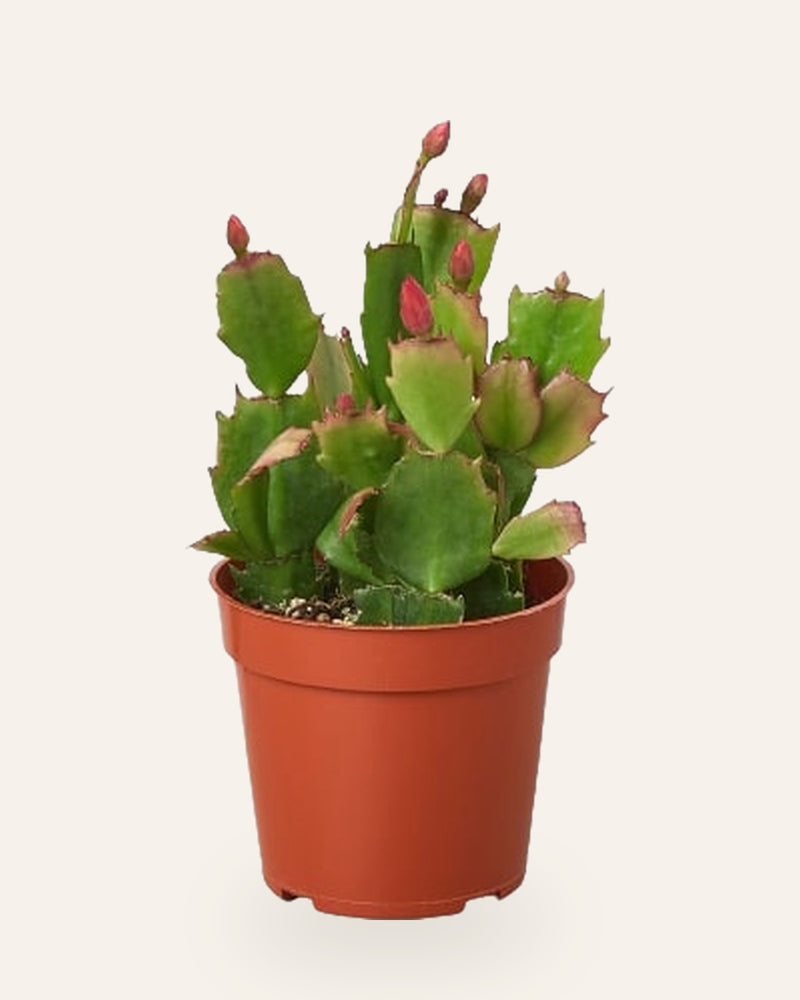
Christmas Cactus
Schlumbergera truncataPot fit: 4" or 6" nursery potWater when the top inch is dry
from $35.98
Madagascar Palm
Pachypodium lamereiWater deeply, then let the soil dry out completely
$32.49
Hoya 'Sunrise'
Hoya 'Sunrise' (Hoya lacunosa x obscura)Pot fit: 4" or 6" nursery pot from $32.99
Hoya 'Crassipetiolata'
Hoya crassipetiolataPot fit: 4" nursery pot $38.99Keep going with the care library
Care pages by plant, plus the watering and light calculators and the plant doctor.
More from the Journal
All Journal articles
Philodendron Congo Care: Light, Water and Fixes for Leaf Problems
How to care for Philodendron Congo: light, watering, soil, repotting and propagation, plus fixes for yellow, brown or droo...

Begonia Care Guide: Light, Water and Dark-Leaf Varieties
Care for indoor begonias including Begonia 'Black Magic' with practical advice on indirect light, watering, humidity, and ...


Homalomena Care Guide: Light, Water and Camouflage Foliage
Learn how to grow Homalomena indoors, including Homalomena 'Camouflage', with tips on medium light, steady moisture, and h...