Money Tree (Pachira aquatica)
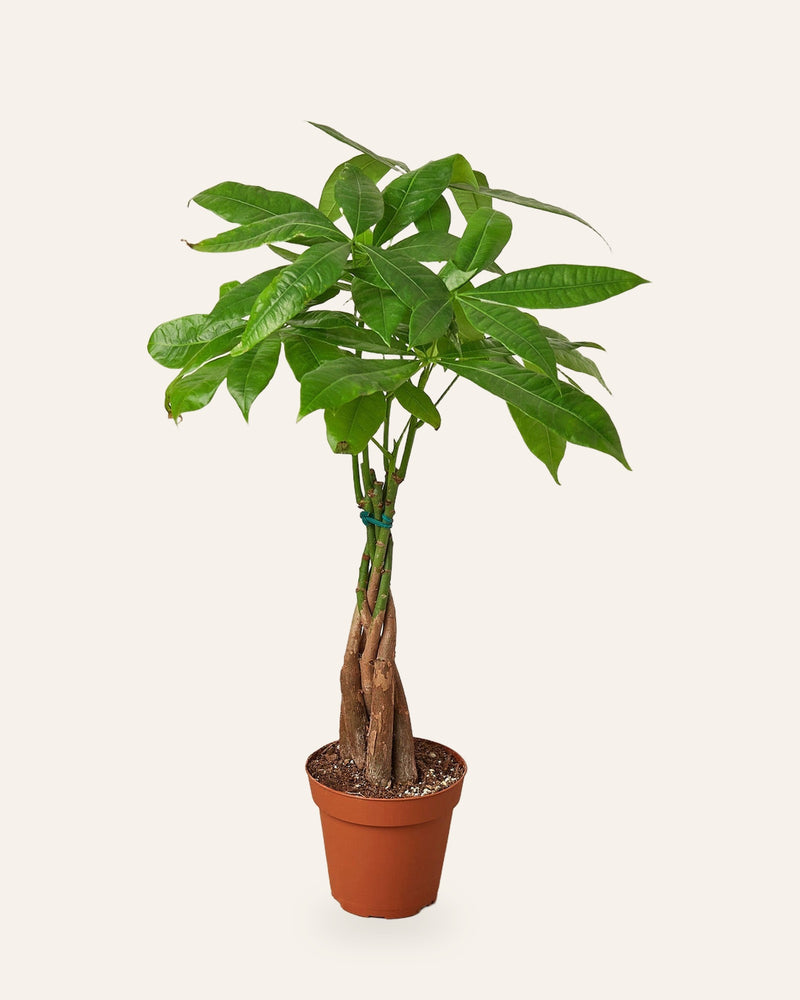
The Money Tree (Pachira aquatica, also known as the Guiana Chestnut) is a majestic wetland tree native to the tropical riverbanks and estuaries of Central and South America. Renowned for its distinctive braided wooden trunk and vibrant palmately compound crown of bright green leaflets, the Money Tree is one of the most popular, pet-friendly architectural statement plants in the world.
Do not confuse the Money Tree (Pachira aquatica, a woody tree with hand-shaped compound leaves) with the Chinese Money Plant (Pilea peperomioides, a compact succulent herb with round coin-shaped leaves in the Urticaceae family). Their mature size and care needs are different; verify pet guidance for the exact botanical name.
Care Science & Diagnostic Tools
Yellow & Brown Leaf Triage
Triage leaf drop: differentiate overwatering and trunk rot from dry drafts and acclimation stress.
Tropical Soil Recipe Maker
Formulate loose, well-draining potting substrate with peat, perlite, and coarse sand.
Non-Toxic to Cats & Dogs
The ASPCA lists Pachira aquatica as non-toxic to cats and dogs. Ingestion of plant foliage in large amounts can still cause mild non-toxic digestive upset.
Money Tree Care at a Glance
Medium to bright indirect light. Avoid harsh direct midday sun that scorches the leaves.
Check the mix before watering and let the upper layer begin to dry. Water the root ball and drain fully; do not leave the trunk base or roots in standing water.
Use a well-draining houseplant mix and a pot with drainage holes. Adjust watering to the mix and growing conditions.
65°F–80°F (18°C–27°C). Rotate pot 90° weekly so the braided canopy grows evenly toward light sources.
Available Money Tree Plants & Braided Sizes
Feng Shui & Prosperity Symbolism
In traditional East Asian culture and Feng Shui principles, Pachira aquatica is revered as a symbol of good luck, vitality, and wealth. The iconic braided trunk represents locking in positive energy, while each compound stem typically features 5 leaflets symbolizing the 5 fundamental elements: Wood, Fire, Earth, Metal, and Water.
Indoor Care vs Tropical Tree Growth
In its native Central American river estuaries, Pachira aquatica grows up to 60 feet tall and produces large woody seed pods known as "Malabar chestnuts." Indoors, juvenile green stems are hand-braided while pliable by nursery growers, restricting growth to a manageable 3 to 6-foot indoor statement tree.
Looking for the "Chinese Money Plant" (Pilea)?
Braided Money Tree (Pachira aquatica) vs. coin-leaved Chinese Money Plant (Pilea peperomioides).
Care and problem-solving references: NC State Extension: Pachira aquatica; ASPCA: Money tree.